

As the temperature drops, you may observe changed in your skin, immune system, and even mood. However, did you know that the cold weather can also have an impact on your oral health?
Lets go over what problems may arise, and how you can both prevent and treat this issues!
Increased Tooth Sensitivity (Dental Allodynia)
Similar to eating ice-cream and other chilly foods, the cold air and atmosphere can trigger pain in your teeth, ranging from mild to sharp. This is especially pronounced if you have exposed dentin, weakened enamel or recessed gums (as well as other issues). Scientifically, this issue is named as ‘Dental Allodynia’.

As the temperature changes, often sudden, from the warmth of your home to the frigid outdoor air, your teeth will expand and contract (like most materials). As a result, tiny cracks can form in the enamel of your tooth. The enamel, the outermost layer of your tooth, protects the sensitive layers underneath such as the dentin. These cracks expose the dentin to the outside environment, causing sensitivity to cold (and similarly in hot) temperatures.
During the winter, as a result of getting less sunlight, vitamin D deficiencies become more prevalent. Due to vitamin D aiding with enamel strength and growth, this deficiency may also result in increased tooth sensitivity.
In essence, fluctuations of temperature can lead to cracks in the enamel, causing sensitivity to the sensitive areas underneath. Imagine a suit of armor with cracks in it. that wouldn’t be very effective in protecting the wearer!
Dry Mouth (Xerostomia)
Dry mouth, also knows as xerostomia, in essence is the reduction of saliva production, resulting in, you guessed it, a ‘dry-er’ mouth. In oral health, saliva plays the crucial role of maintaining mouth pH, keeping bacteria in check, and acting as a lubricant to reduce friction in and around our mouth.

During cold weather, we often find ourselves inside more often with the heating turned up. Whilst the heating brings comfort from the cold, it comes at the cost of drying up the air. Similarly, the cold air outside holds less moisture, thus also drying our mouth. In essence, this presents a lose-lose scenario, where indoor heating decreases humidity, and the outside cold gives dry air.
Not only does having a dry mouth cause discomfort, it can also lead to other oral health problems.
Having dry mouth naturally means having less saliva, a component of our oral health that washes away bacteria, neutralizes acids, and overall cleaning of the mouth. As a result of decreased saliva, you may become more susceptible to cavities (tooth decay), gingivitis and bad breath (stinky).
Other tissue infections and ulcers may arise as well, including canker sores that we will talk about in the next section.
Basically, a dry mouth isn’t just uncomfortable, but may lead to serious oral health issues!
Canker Sores
The risk of canker sores are another ‘gift’ that the cold weather brings (did you get my sarcasm?). Thankfully, unlike cold sores, canker sores are not contagious. Canker sores are a type of mouth ulcer, presenting as a painful white and/or yellow ulcer surrounded by a bright red area.
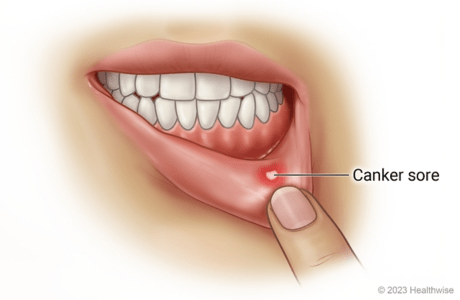
Saliva is crucial for ‘flushing’ away bacteria and food particles that can lead to infection. As a result of mouth dehydration (xerostomia), the mouth is exposed to more germs and irritant, increasing the likelihood of canker sores.
A weaker immune system, due to your body fighting cold environments, can also lead to increasing your susceptibility to canker sores.
During winter, another effect is changes in diet and routine. Festive eating, and nutritional deficiencies may lead to increasing the likelihood of getting canker sores.
Increased stress, which may be brought on by the cold weather and lack of sunlight, can also influence susceptibility to canker sores. Both psychological and behavioral stresses can often times lead to physical health issues.
Although not typically ‘dangerous’, canker sores are very uncomfortable and may, in severe situations, require some sort of medication.
Colds and Flu’s
With fall and winter comes the cold and flu season. Viruses spread more easily indoors, and paired with cold weather decreasing the effectiveness of our immune systems, lets just say that staying in bed all day isn’t always as fun as it sounds!

Getting the cold and the flu may also include sinus infections and other respiratory illnesses. These issues put pressure on dental nerves, resulting in increased tooth sensitivity and pain. Clogged noses also require us to breathe through our noses, furthering dry mouth and saliva production.
Having a weaker immune system can also increase the likelihood of gum diseases, making it harder for the body to fight all forms of infections, including oral.
Cold and flu medications often have the drawback of being detrimental for our oral health. Often containing sugars, sticky syrups, and other complications.
Although the cold and flu may not directly effect our oral health like it does for our nose and throat, the body often works as a full system. Where one part suffers, so too does the rest!
What Can We Do About It?
Luckily there are many ways to help prevent and treat oral health issues that may arise due to the cold weather season.
Keep up with your oral hygiene, making sure to brush and floss regularly. This will help with the ‘flushing’ aspect of dry mouth, keeping bacteria away, getting rid of sugars and sticky syrup, as well as aiding with tooth enamel recovery. In general, oral hygiene practices will help to prevent cavities, and other tooth/gum decay, maintaining oral health strength.
Maintain a balanced and healthy diet, being mindful of vitamin and mineral consumption that can positively benefit oral health. Of note is vitamin D, aiding with tooth enamel recovery and strength.
Although we can not control the outside cold air, perhaps maintaining a certain amount of humidity at home can limit dry mouth at home.
Oral hygiene practices and a healthy diet can also help with giving our immune system the support it needs, furthering our body’s ability to combat the cold and flu! It’s also not a bad idea to stay warm and bundled up!
To help with stress and emotional distress during the cold, and often dark, season, take part in meditation and other inner-peace related practices. Try to also get a some sun, promoting peace and providing you with vitamin D.
Lastly, make sure to keep up with your oral health checkups with dental professionals. That way you’ll know what’s up with your oral health, and how better you can maintain it!
In Sum
The cold weather season, while providing fun activities and the occasional school snow day, can lead to oral health issues and pain.
We went through how temperature changes can effect oral sensitivity, as well as how lack of nutrition, dry mouth and immune system complications can lead to a decrease in oral health and result in issues.
Thankfully, with the proper upkeep of our oral hygiene, environment, nutrition and catching some ‘rays’ (as the cool kids say), as well as oral professional check-ups, we can get through the cold weather, and make it to a sunnier season!
References:
Botelho, J., Machado, V., Proença, L., Delgado, A. S., & Mendes, J. J. (2020). Vitamin D Deficiency and Oral Health: A Comprehensive Review. Nutrients, 12(5), 1471. https://doi.org/10.3390/nu12051471
Cansu, D. Ü., Kaşifoğlu, T., & Korkmaz, C. (2014). Is there any relationship between season/weather and oral ulcer in Behçet’s disease?. European journal of rheumatology, 1(3), 89–91. https://doi.org/10.5152/eurjrheumatol.2014.031
Dentist Oakville. (2025, February 25). How the Cold, Dry Winter Affects Your Overall Oral Health. Oakville Place Dental Office. https://www.dentistoakville.com/blog/how-the-cold-dry-winter-affects-your-overall-oral-health/
Howland, J. (2024, January 16). Mayo Clinic Minute: Can cold weather cause a cold? – mayo clinic news network. Mayo Clinic. https://newsnetwork.mayoclinic.org/discussion/1-16mayo-clinic-minute-can-cold-weather-cause-a-cold/#:~:text=%22If%20you’re%20a%20little,t%20cause%20the%20common%20cold.
Le Fur-Bonnabesse, A., Bodéré, C., Hélou, C., Chevalier, V., & Goulet, J. P. (2017). Dental pain induced by an ambient thermal differential: pathophysiological hypothesis. Journal of pain research, 10, 2845–2851. https://doi.org/10.2147/JPR.S142539
Shargorodsky, J. (2023, April 6). Canker sore. Mount Sinai Health System. https://www.mountsinai.org/health-library/diseases-conditions/canker-sore#:~:text=A%20canker%20sore%20is%20a%20common%20form%20of%20mouth%20ulcer,or%20trauma%20in%20the%20mouth.




Leave a Reply